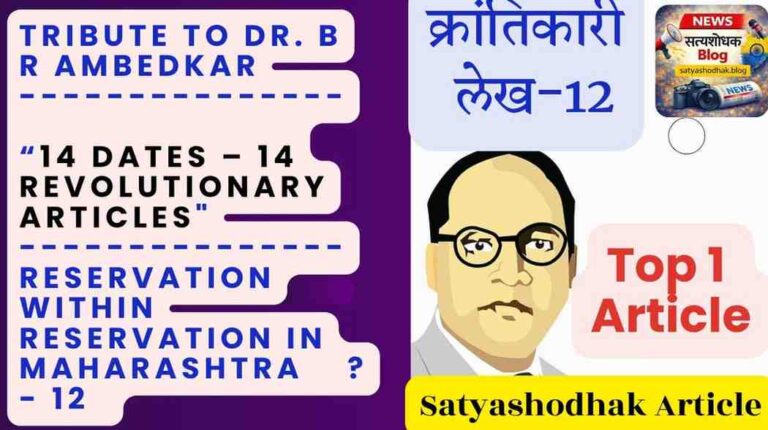
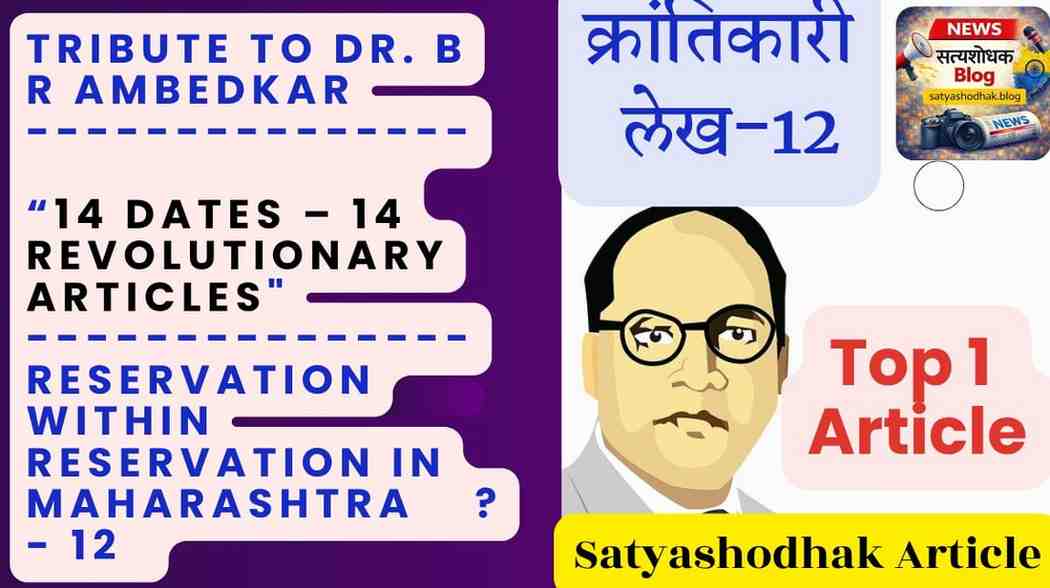
Is reservation within reservation in Maharashtra a step toward justice or division? A powerful Ambedkar Jayanti special analysis.
Contents
Reservations Within Reservation in Maharashtra : A diccussion ¡
Introduction:
Reservation Within Reservation in Maharashtra : Government’s GR on 10 th April 2026 related to subdivision of Sheduled Castes Reservatin 13% in Mahatashtra creates questions and confusion in people in Maharashtra especially educated layer and political workers, observers and experts in this topic. Principle of representation of Sheduled Castes in education, government jobs etc.
Reservation Within Reservation in Maharashtra : A Question That Shakes the System
•Is reservation meant to unite the marginalized—or divide them further?
Just days before a controversial decision by the has sparked intense debate across the state.
A Government Resolution (GR) dated April 10 proposes sub-reservation within Scheduled Castes (SCs)—raising questions about fairness, transparency and political timing.
Did you know? Maharashtra has 59 Scheduled Castes but benefits of reservation have historically been concentrated among a few dominant groups.Reservation Within Reservation in Maharashtra can be a forward step towards social Justice in Maharashtra?
Let’s explore the truth behind this policy, its impact and why it matters now more than ever.
What is ‘Reservation Within Reservation’ in Maharashtra?
The concept of “Reservation within Reservation” refers to dividing the existing SC quota into smaller segments for different sub-castes.
In Maharashtra the SC reservation is around 13%. Now the government is proposing to internally divide this percentage among various castes.
•The intention?
To ensure that smaller and underrepresented SC communities get a fair share of opportunities.
•The concern?
This could create divisions among historically oppressed communities.
Understanding the SC Demographics of Maharashtra
Total Scheduled Castes: 59 Communities/Castes
Maharashtra officially recognizes 59 Scheduled Castes each with unique social, cultural and economic backgrounds.
You can explore the official list here:
https://socialjustice.gov.in
Major Population Groups
•Nav Buddhists (Neo-Buddhists)
The largest segment within SCs
•Followers of ’s movement of conversion to Buddhism
•Strong presence in urban and semi-urban areas
•Matang Community/Caste
•The second-largest SC group in Maharashtra
•Historically marginalized with lower access to education and jobs
Did you know? Many smaller SC communities claim that they have been left behind despite decades of reservation policies.
The 13% Reservation – How is the Government Dividing It?
The government’s proposal suggests dividing the 13% SC reservation among different caste groups based on:
•Population proportion
•Historical backwardness
•Access to education and employment
However no detailed formula or data has been publicly released.
This lack of clarity has led to confusion and protests.
April 10 GR – Why the Timing? Raises Questions
On April 10 the government issued a GR (Government Resolution) regarding this policy.
Key Issues:
Objection deadline: April 15 (just 5 days!)
Ambedkar Jayanti on April 14 falls within this period
This has raised serious concerns:
•Why introduce such a sensitive policy just before Ambedkar Jayanti?
•Is the short objection window enough for meaningful public participation?
Did you know? Many activists believe this timing may reduce organized opposition due to ongoing celebrations.
Ambedkar Jayanti – Unity or Silent Tension?
Is not just a celebration—it’s a symbol of equality, dignity and unity.
Before the GR:
•SC communities celebrate together
•Youth participate in rallies, speeches and cultural events
After the GR:
Discussions are shifting toward internal divisions
Youth are debating: “Who deserves how much?”
This shift is deeply emotional and politically sensitive.
Lack of Transparency – Where is the Data?
One of the biggest criticisms is:
❗ The Maharashtra government has not released the full report or study behind this decision.
Questions being asked:
•What data supports sub-reservation?
•Which communities are underrepresented?
•How were percentages calculated?
•Without answers trust becomes difficult.
How Can Citizens Raise Objections? (Confusion Prevails)
The GR allows citizens to submit objections till April 15.
But major concerns include:
❓ Which draft document should be referred to?
❓ Where exactly should objections be submitted?
❓ Is there an official public consultation platform?
•This lack of clarity limits democratic participation.
You can check policy processes here:
https://maharashtra.gov.in
The Need for Deep Research – Not Quick Decisions
Experts argue that sub-reservation requires deep sociological and economic study including:
•Educational access data
•Employment statistics
•Regional disparities
•Historical discrimination patterns
Major demand is census based on Castes all over contry.
A rushed decision can create long-term divisions instead of solutions.
Real-Life Ground Impact – Voices from Society
Example 1: A Village in Marathwada
A Matang student says:
“We never got benefits like others. Maybe sub-reservation will help us.”
Example 2: Urban Pune Youth (Nav Buddhist)
“This will divide us. Instead of fighting inequality, we’ll fight each other.”
Example 3: Community Leaders
“We need data, not politics.”
Did you know? Similar debates have occurred in states like Karnataka ?
Is Sub-Reservation Constitutional?
The idea of sub-classification within SCs has been debated legally in India.
• If state government feel nessesorry it can take decision on subjects like this.
For reference:
https://indiankanoon.org
Some Supreme Court observations suggest:
•Sub-classification may be allowed
•But must be based on solid empirical data
Internal links:
Ambedkar Jayanti Celebration Guide
Indian Constitution and Social Justice Articles
Caste Census and Reservation Policy Explainers
The Bigger Question – Justice or Division?
This issue is not just about percentages.
It’s about:
•Representation
•Historical injustice
•Unity among marginalized communities
Will sub-reservation uplift the most deprived—or create new inequalities?
Conclusion:
A Critical Moment for Maharashtra
As Maharashtra approaches this debate becomes even more significant.
Reservation within reservation is not just a policy—it’s a test of:
•Government transparency
•Social unity
•Commitment to justice
The need of the hour is dialogue, data and democratic participation—not rushed decisions.
• What do you think about sub-reservation?
• Share this article to spread awareness
•Start a discussion in your community
Because informed citizens build a stronger democracy.
FAQs:
Q1. What is reservation within reservation in Maharashtra?
Reservation within reservation means dividing the existing SC quota (13%) among different sub-castes (59) to ensure fair representation.
Q2. Why is the April 10 GR controversial?
Because it was introduced just before Ambedkar Jayanthi with only a 5- day objection window and without detailed public data.
Q3. Who benefits from SC sub-reservation?
Smaller and underrepresented SC communities may benefit but the policy’s impact depends on proper implementation and transparency.
About The Author