Date 14-14 Revolutionary Articles by Dr. Nitin Pawar ,A tributary series
Introduction
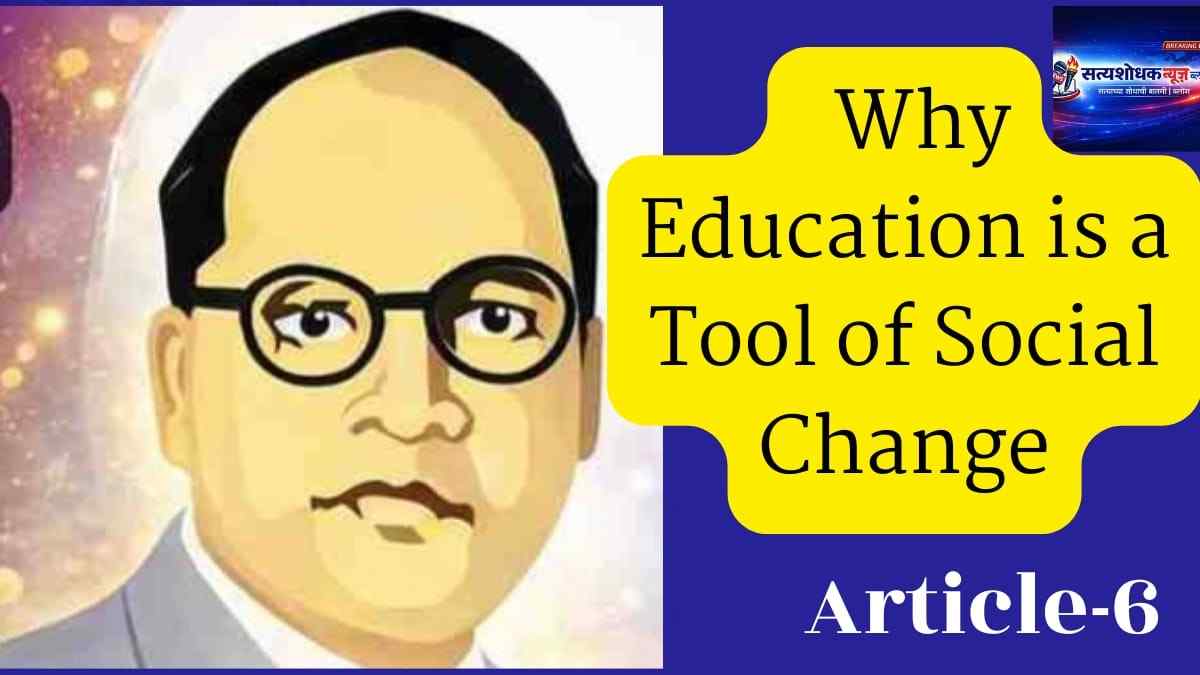
Ambedkar Jayanti 2026 Education highlights why education is a powerful tool of social change according to Ambedkarite vision.
Ambedkar Jayanti 2026 Education is a part of my Tribute Articles to Babasaheb – “14 Date – 14 Revolutionary Articles”. Today is why Babasaheb in whole of his life give more stress on Education of people?
Babasaheb always been a powerful force for transformation, but few leaders emphasized on education importance as strongly as he to change society. Especially Indian society as it is a very complex structure. Longest social structure in world. It remained static for nearly about 2000 years.
Ambedkar Jayanti 2026 Education education was not just about acquiring knowledge. It was about empowerment, equality, and social justice.
Why Education as Empowerment?
Ambedkar believed that education is the key to breaking the chains of oppression. His famous call — “Educate, Agitate, Organize” — was a roadmap for social transformation.
Ambedkar Jayanti 2026 6 remarks Babasaheb’s mind in references to education. We should remember it again and again.
Education empowers individuals to think critically, question injustice, and claim their rights. It develops scientific temperament in mind through education. It transforms not only individuals but entire communities.
Education Bridging Social Inequality
One of the biggest challenges in any society is inequalities. It may be based on caste, class, religion, sex, colour, poverty or development.
Ambedkar understood that without equal access to education, true equality is impossible.
Here I can notice that education designer’s role should be impartial, scientific, ethical, rational. Otherwise aim to educate people fails.
Access to higher education becomes impossible due to poverty — it is failure of Government and society.
भारतात सामाजिक बदल घडवण्यासाठी आवश्यक असलेली टॉप 10 साधने – आंबेडकर विचारांवर आधारित विशेष लेख (Article 6)
Top 10 Tools for Social Change in India:
Social change in India is not sudden — it is a continuous, structured process.
It is built on education, law, awareness, and collective action.
1. Education (The Fundamental Weapon)
Education is the most powerful tool for social transformation.
Builds critical thinking
Creates awareness
Breaks social barriers
Develops scientific mindset
Without education, equality is impossible. 2. Constitution & Legal Rights
The Indian Constitution is the backbone of social justice.
Fundamental Rights
Reservation policies
Legal protection against discrimination
Law gives structure and direction to change. 3. Social Movements
Collective struggles bring real transformation.
Dalit movements
Women’s rights movements
Farmers’ protests
Movements emerge when systems fail. 4. Digital Activism & Social Media
Modern tool of awareness and mobilization.
Hashtag campaigns
Online petitions
Public opinion building
One digital voice can reach millions.
5. NGOs & Civil Society Organizations
Ground-level agents of change.
Education support
Women empowerment
Rural development
They give voice to marginalized communities. 6. Media & Journalism
The mirror of society.
Investigative reporting
Public awareness
Accountability
Media exposes injustice and drives attention. 7. Political Participation
Power structure defines social structure.
Voting
Representation
Policy-making
Change in power leads to change in society. 8. Technology & Innovation
The driver of modern transformation.
Artificial Intelligence
Digital education
E-governance
Technology accelerates change. 9. Collective Community Action
Local participation creates lasting impact.
Self-help groups
Youth initiatives
Grassroots activism
Strong communities build strong nations.
10. Awareness & Critical Thinking
The most invisible yet powerful tool.
Question injustice
Reject blind traditions
Think rationally
Real change begins in the mind.
Conclusion:
Social change in India does not depend on a single tool.
It is the result of a combination of education, law, awareness, and collective action.
Dr. B.R. Ambedkar’s timeless formula still remains the most powerful guide:
“Educate, Agitate, Organize.”
Education in the Digital Era
In today’s digital age, education has expanded beyond classrooms. One can learn at any place and time.
Data Science, Artificial Intelligence, Space Science, Quantum Mechanics, Genetic Engineering, Health Science, Economy, updated research — everything is accessible.
However, the digital divide remains a significant issue. Millions still lack access to quality education and digital resources.
Ensuring inclusive education must remain a global priority.
Lessons for Today’s Youth
Ambedkar’s message to the youth is timeless:
Seek knowledge relentlessly
Challenge inequality
Use education as a tool for change
Young people have the power to reshape society, but today they are somewhat screen dependent,influenced by media, propaganda, fake news, and distractions.
Education and Nation Building
• A well-educated society is the foundation of a strong nation
• Education promotes democratic values
• It drives economic growth
• It builds social responsibility.
Conclusion
Ambedkar’s vision of education goes beyond classrooms — it is about creating a society where everyone has equal opportunities.
Dr. B.R. Ambedkar understood that true freedom is incomplete without knowledge.
Even today, millions of people face discrimination, lack of opportunities, and social barriers. The only sustainable solution is education.
It empowers individuals to think critically and create a better future.
His thoughts remind us that education should reach every corner of society, especially those historically marginalized.
By embracing Ambedkar’s ideals, we move toward a society that values merit, humanity, and justice.
Ambedkar Jayanti 2026 Education:
A Continuing Mission
Ambedkar Jayanti 2026 Education reminds us that education is not a one-time achievement but a continuous mission. In today’s rapidly changing world, knowledge must evolve with time. Society cannot progress if education remains limited to only a few sections.
Even in 2026, many parts of society are still struggling with basic educational access, quality learning, and digital resources. This gap creates inequality not only in knowledge but also in opportunities, power, and decision-making.
Ambedkar’s vision clearly indicates that education must reach the last person in society. Without this, democracy becomes incomplete and social justice remains only a concept.
Therefore, it becomes our collective responsibility to ensure that education is accessible, scientific, and value-based. Only then true social change can be achieved.
👉 “Education is not just a right; it is a tool for revolution.”
Dr. Nitin Pawar is the Founder & Editor of Satyashodhak Blog. He writes on social justice, education, politics and current affairs with a bold, analytical and ground-level perspective.
डॉ. नितीन पवार सामाजिक प्रश्न, शिक्षण आणि राजकारणावर अभ्यासपूर्ण व निर्भीड लेखन करतात.